
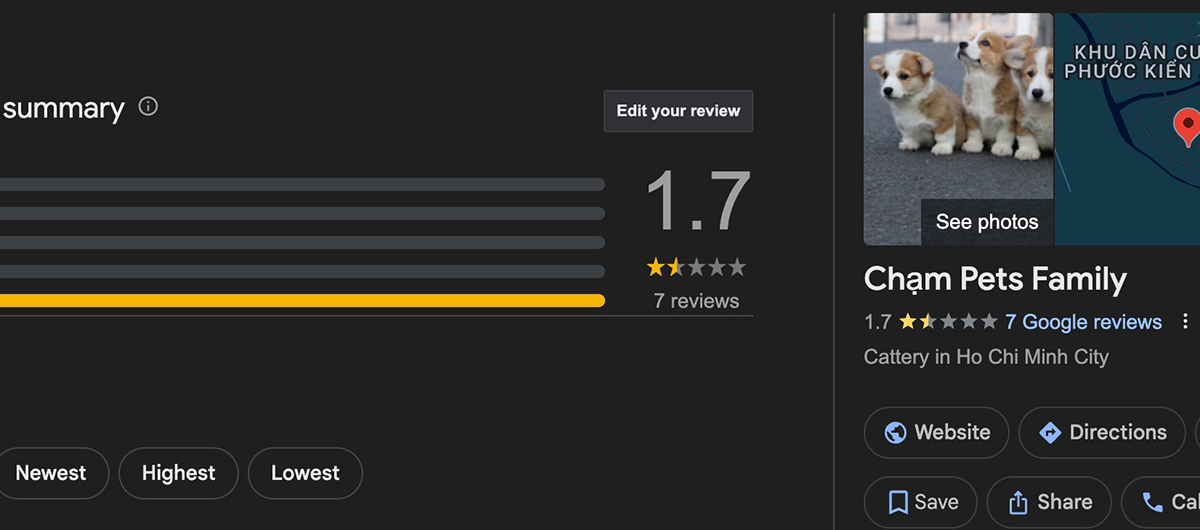
This article documents a real-world consumer transaction involving a deposit paid in Vietnam, where expectations, informal business practices, and the absence of clearly documented terms led to disagreement about outcomes. It is presented as a factual case study rather than a complaint, with the aim of illustrating how ambiguity can arise in cross-cultural consumer contexts, particularly where intermediary businesses, deposits, and informal norms intersect.
The purpose of this piece is not to assign blame or reach conclusions, but to record events as they occurred, distinguish facts from claims, and highlight the practical risks consumers face when customary practices differ from formal contract expectations. Names and details are included only where necessary to preserve accuracy and transparency.
UPDATE: 02 February 2026
On legal advice, I asked a Vietnamese friend to contact Cham Pet by phone to clarify their position regarding the deposit and to explore whether any portion could be returned.
Cham Pet stated that they operate as an intermediary between customers and dog farms. They advised that the full deposit had already been transferred to the farm, and that Cham Pet only receives its commission upon completion of a successful transaction. On this basis, they asserted that they were unable to refund the deposit.
Cham Pet further stated that because no “trial period” was raised prior to the deposit being paid, and because they do not operate a trial policy, the decision not to proceed constitutes a breach of contract, resulting in forfeiture of the deposit.
When the possibility of a partial refund was raised as a goodwill compromise, the staff member indicated she would need to consult with her supervisor and would provide a response at a later time.
No written contract, formal terms of sale, or forfeiture conditions were provided to me prior to the deposit being paid. I am therefore documenting all communications carefully and will continue to update this case study as further information becomes available.
Legal and consumer-logic context (for non-Vietnamese readers)
In Vietnam, particularly in small and medium family-run businesses, deposits are commonly treated as signals of intent rather than as fully articulated contractual instruments. Written contracts, explicit refund policies, and clear disclosure of forfeiture terms are often absent unless the transaction involves large sums, foreign entities, or regulated industries.
Intermediary businesses may position themselves as facilitators rather than sellers, even when they collect deposits directly from customers. This can create ambiguity around who holds responsibility when a transaction does not proceed.
From a consumer-law and basic contract-logic perspective, several points are relevant:
- A binding contract normally requires clear disclosure of material terms, including refundability and forfeiture conditions, prior to payment.
- The absence of a written agreement or explicit forfeiture clause weakens claims that a customer has breached a contract.
- A deposit paid during an enquiry or selection phase is not automatically equivalent to completion of a transaction.
- Good-faith negotiation and proportional remedies, such as partial refunds, are commonly expected where no explicit terms were agreed.
This case study is not an assertion of wrongdoing. It is a contemporaneous record of how pressure, ambiguity, and asymmetry of knowledge can operate in real-world consumer transactions, particularly where cultural expectations differ and formal protections are unclear.
Established facts
- An initial enquiry was made with Cham Pet regarding the purchase of a family dog.
- A monetary deposit was paid to Cham Pet.
- No written contract, terms of sale, refund policy, or forfeiture conditions were provided prior to the deposit being paid.
- No trial period, cooling-off period, or inspection arrangement was documented in writing.
- After further consideration, a decision was made not to proceed with the purchase.
- On legal advice, Cham Pet was contacted by phone via a Vietnamese friend to clarify Cham’s position regarding the deposit.
- Cham Pet confirmed by phone that they consider themselves an intermediary between customers and dog farms.
- Cham Pet stated that the deposit had already been transferred to the dog farm.
- Cham Pet stated that they receive a commission only once a transaction is completed.
- Cham Pet declined to refund the deposit at the time of the call.
- When asked about a partial refund, Cham Pet indicated they would consult with a supervisor and respond later.
Claims made by Cham Pet
- That Cham Pet acts solely as an intermediary and therefore bears no responsibility for refunding the deposit.
- That the deposit constituted part of a completed transaction rather than an enquiry or reservation.
- That the absence of a pre-agreed trial period places the customer in breach of contract.
- That forfeiture of the full deposit is justified on this basis.
- That Cham Pet does not operate any trial policy.
Points currently unresolved
- Whether any contractual relationship existed in the absence of written terms.
- Whether forfeiture conditions were disclosed clearly and in advance.
- Whether the deposit was proportionate to the stage of the transaction.
- Whether a partial refund is possible or appropriate.
- Whether the dog farm itself has been consulted or is able to return funds.
This timeline will be updated as further information becomes available.
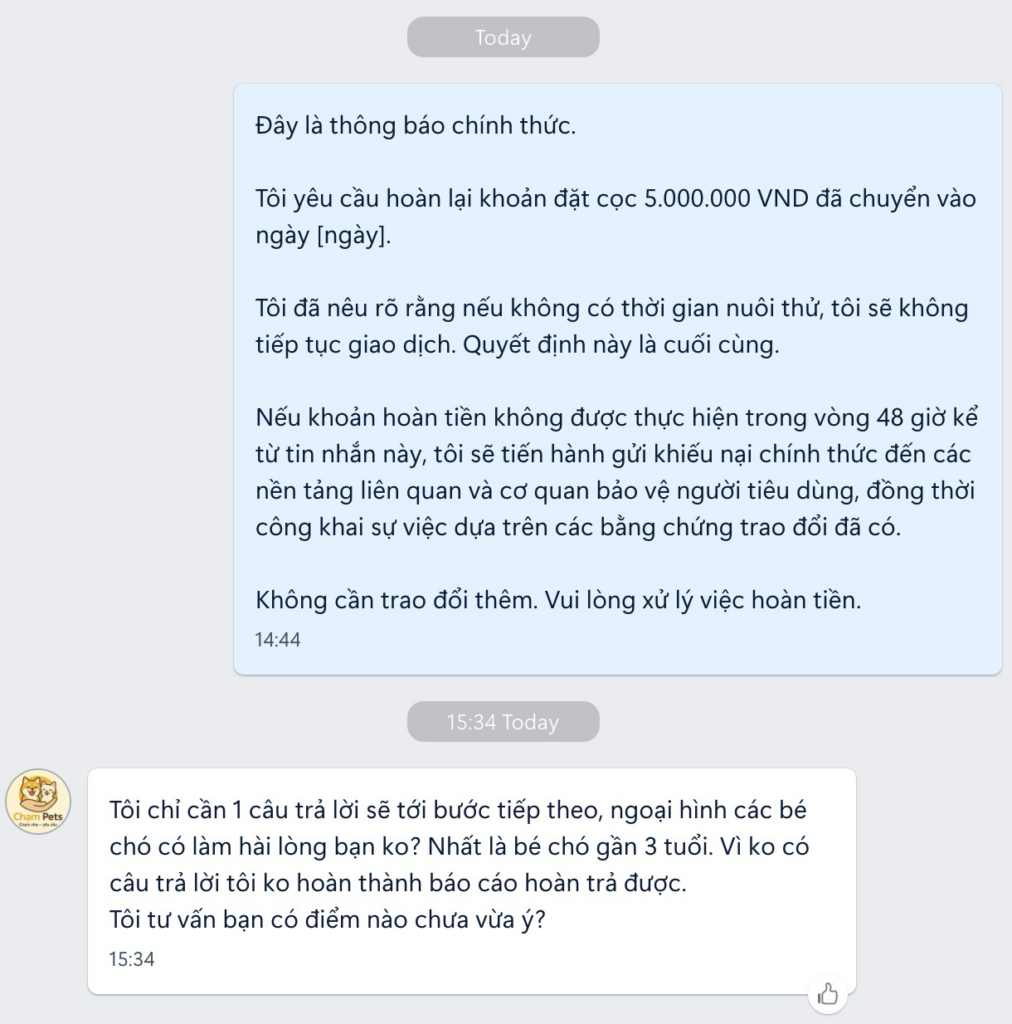
The screenshots below are presented in chronological order to illustrate how the interaction evolved.
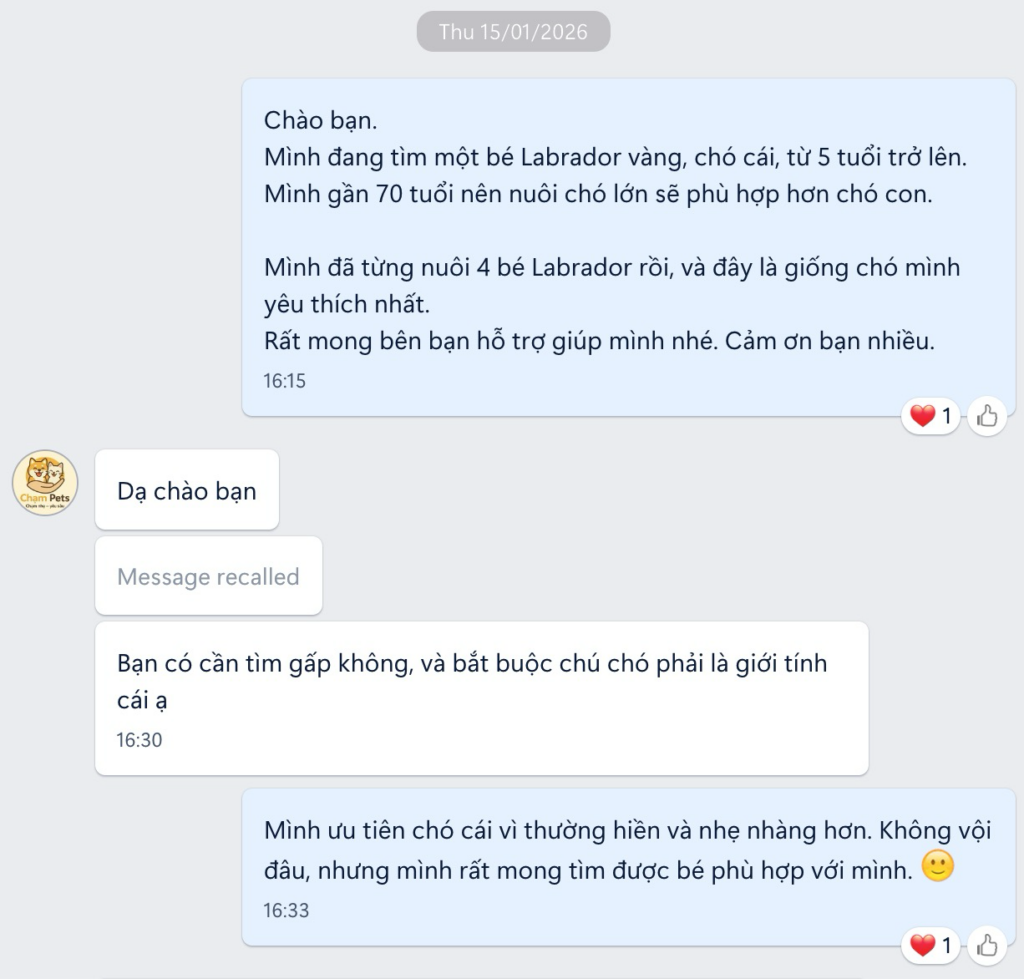
This interaction began well. Warm, human, professional enough to inspire confidence.
I was looking for an older female Labrador. Not a puppy. I was explicit about my age, my energy levels, and my long familiarity with the breed. Suitability mattered more to me than speed, and I communicated that clearly from the outset.
Cham Pets Family responded promptly and politely. They asked clarifying questions, offered options, and appeared willing to work collaboratively. At that stage, this looked like the beginning of a sensible, adult business relationship.
I was comfortable proceeding.
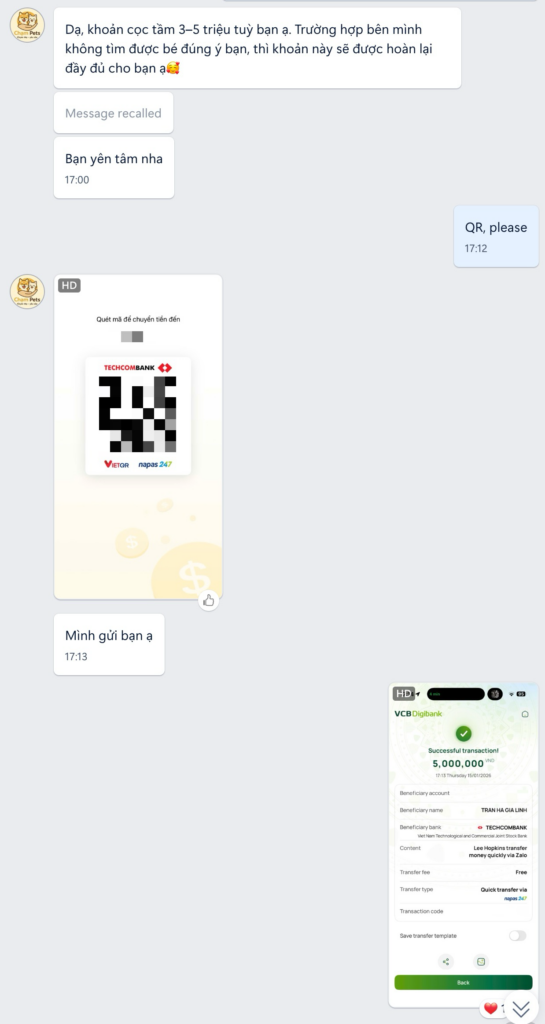
I was asked to and paid a 5 million VND deposit, on the explicit understanding that we were still in an exploratory phase and that fit, health, and process mattered more than momentum.
This is where the tone began to shift.
Phase one. Cooperative and professional.
Early messages from Cham Pets Family were courteous and aligned with what had been discussed.
They reassured me that they would look for dogs matching my criteria and that logistics could be handled flexibly depending on location. Questions were answered promptly, and the overall tone suggested competence and goodwill.
Trust was present.
So was optimism.
Phase two. Subtle pressure emerges.
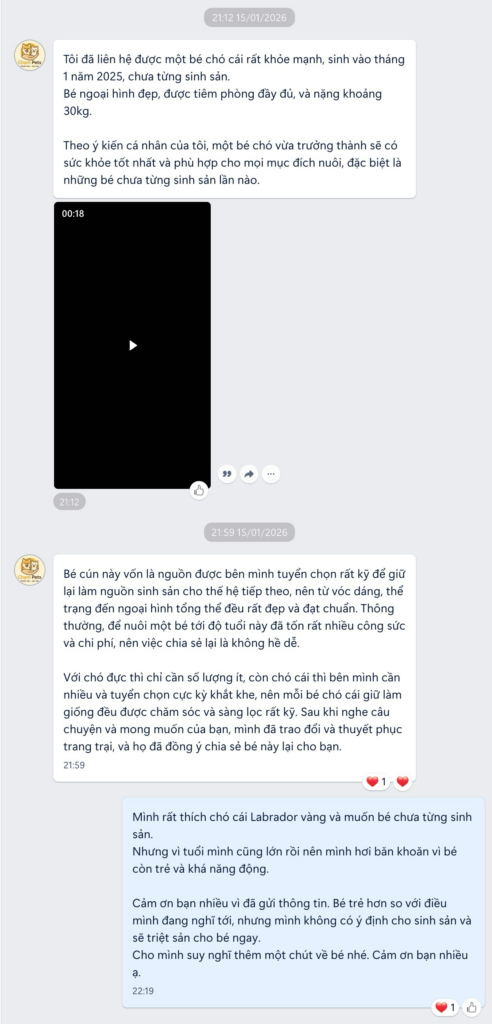
The dogs proposed were younger than requested. One was close to three years old. Another was approximately one year old.
I raised a reasonable concern. Energy levels, long-term fit, and the realities of introducing a dog into an older household.
I then asked a single, clear question.
Could there be a two-week trial period to ensure the dog was genuinely suitable?
The response was immediate.
Cham Pets Family stated they did not offer trial adoption.
That position, by itself, was not a problem. Businesses are entitled to their policies. What mattered was what followed.
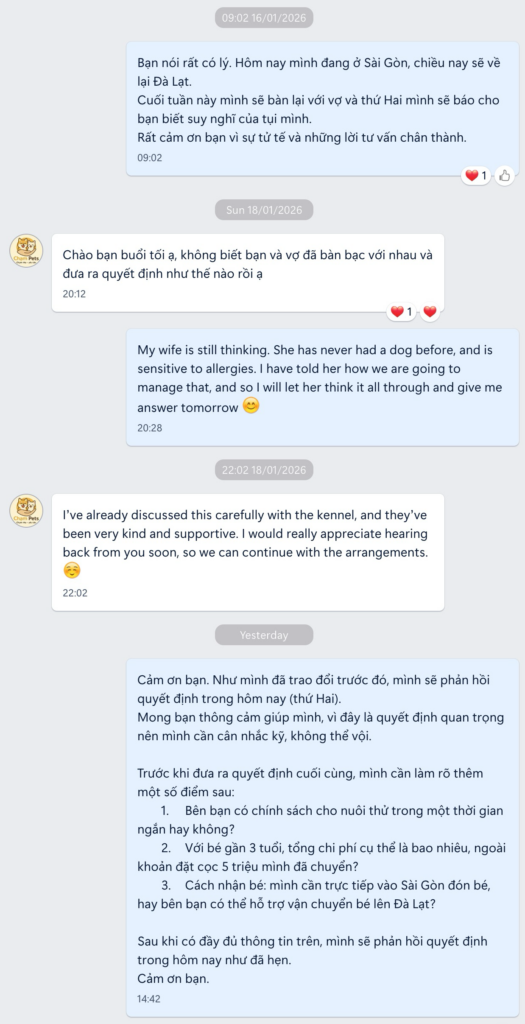
Phase three. Policy turns into persuasion.
Rather than accepting that the absence of a trial might end the transaction, the conversation shifted direction.
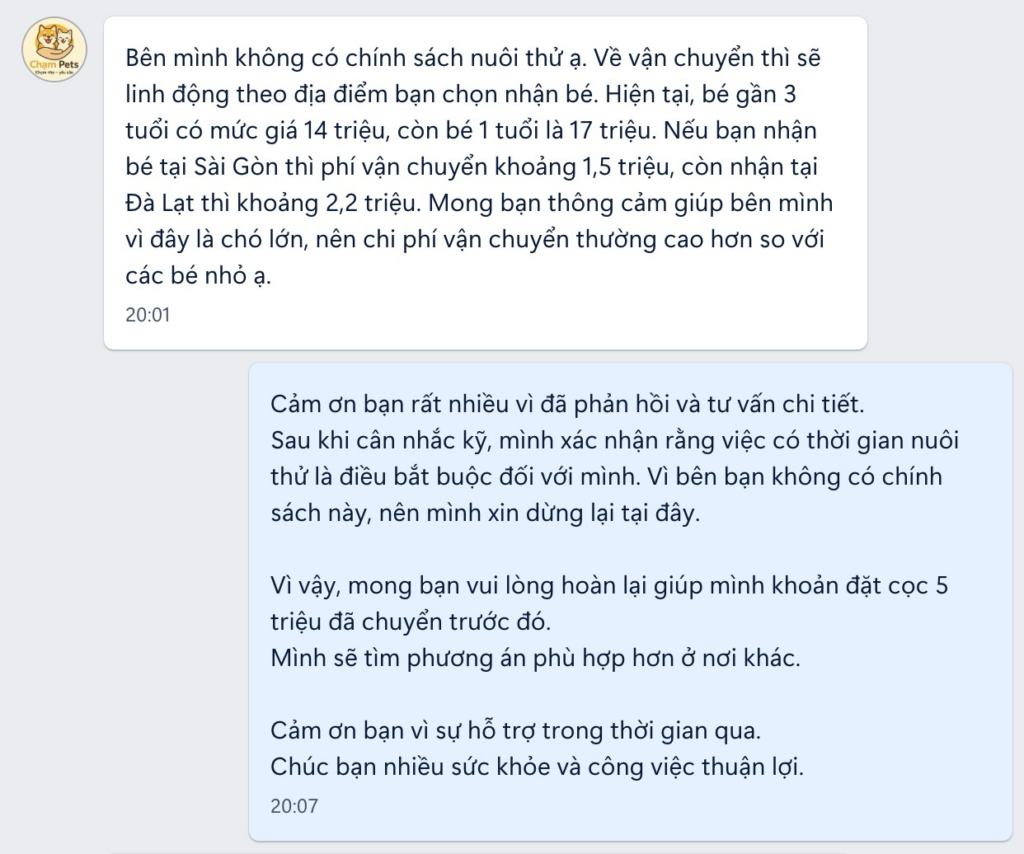
I was repeatedly asked whether I disliked the dogs’ appearance. I was pressed to explain why I could not accept either dog. Health guarantees were offered in place of time spent living with the animal.
This reframing was significant.
The issue was no longer process.
It was being repositioned as my personal objection.
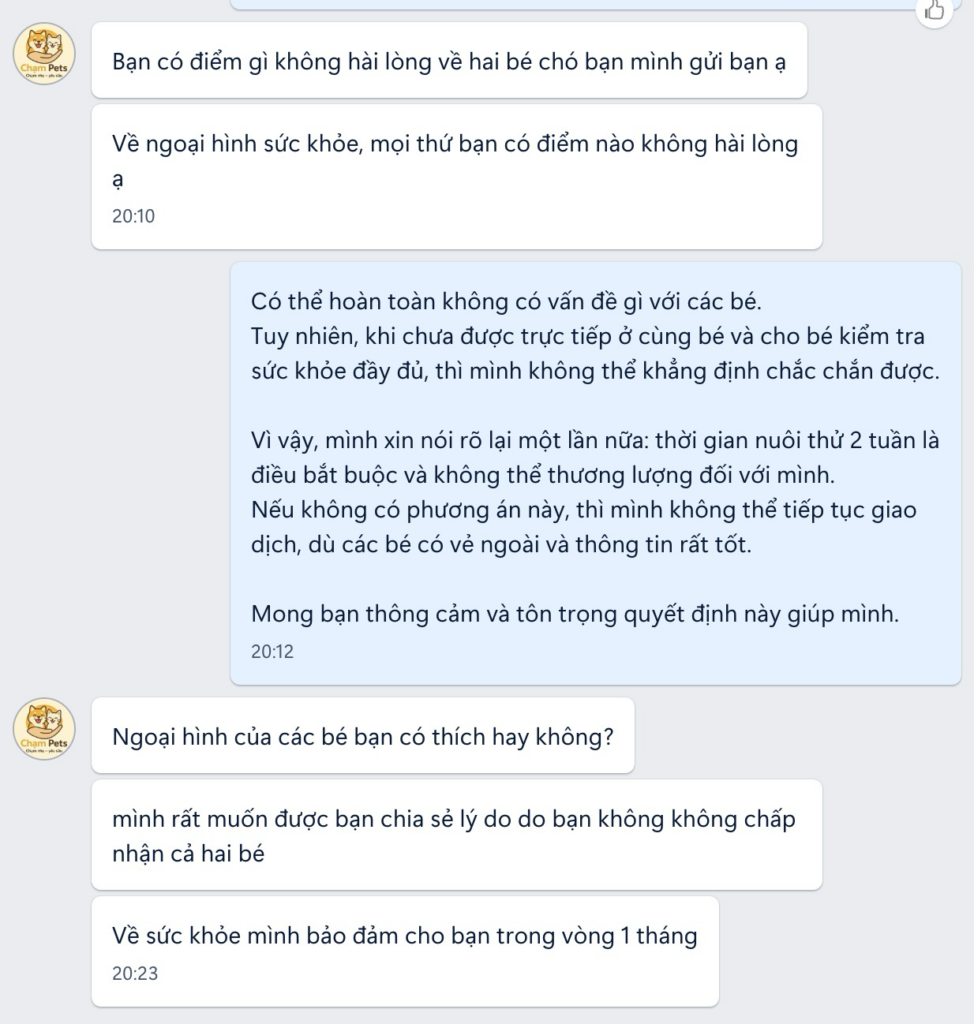
This is a familiar pattern in low-trust micro-businesses. When systems are weak, persistence is used to compensate. The conversation becomes about persuasion rather than structure.
I clarified again. There was probably nothing wrong with the dogs. Without living with them and arranging independent checks, I could not know. A two-week trial was non-negotiable.
The questioning continued.
Phase four. Money changes everything.
At this point, I made my position explicit. Without a trial period, I would not proceed, and I requested the return of my deposit.
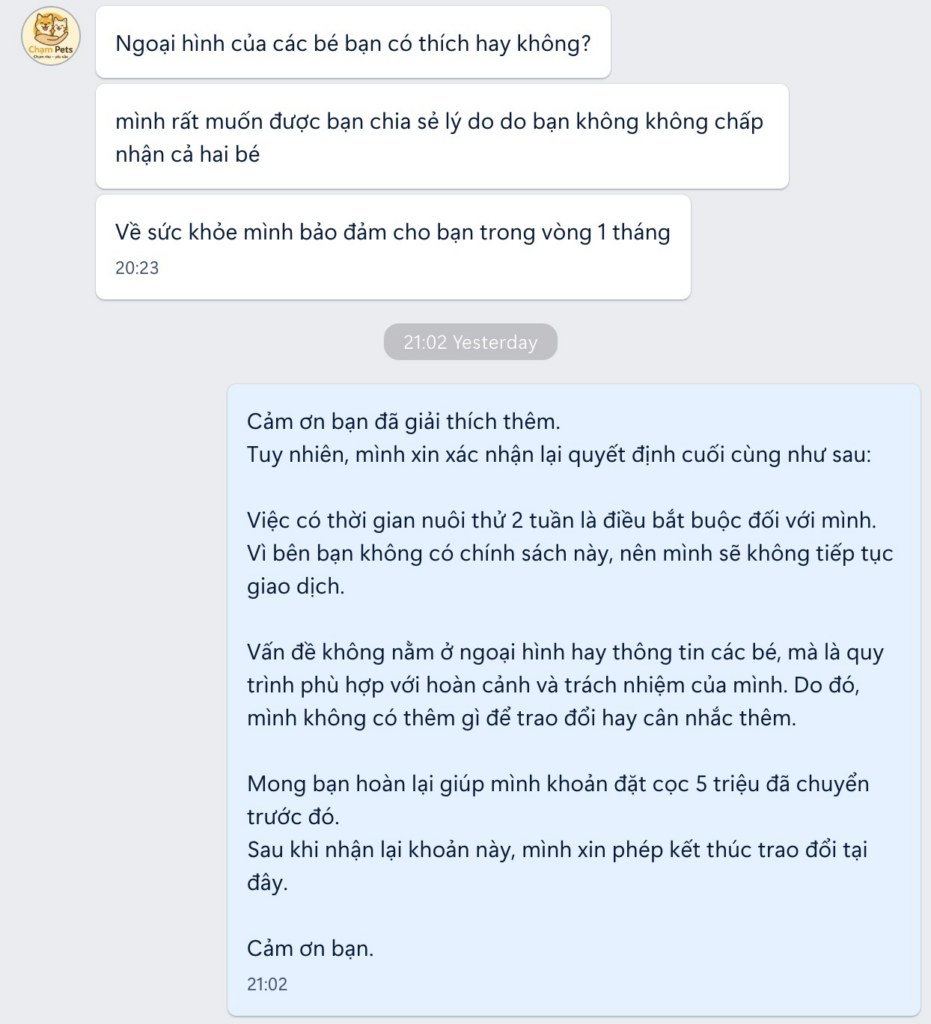
This is where the interaction deteriorated rapidly.
Instead of processing the refund, Cham Pets Family continued pressing for explanations. They emphasised their effort, the number of options they had provided, and repeatedly asked why I would not simply answer their questions so that “the conversation could continue”.
This was no longer a sales discussion. It was pressure.
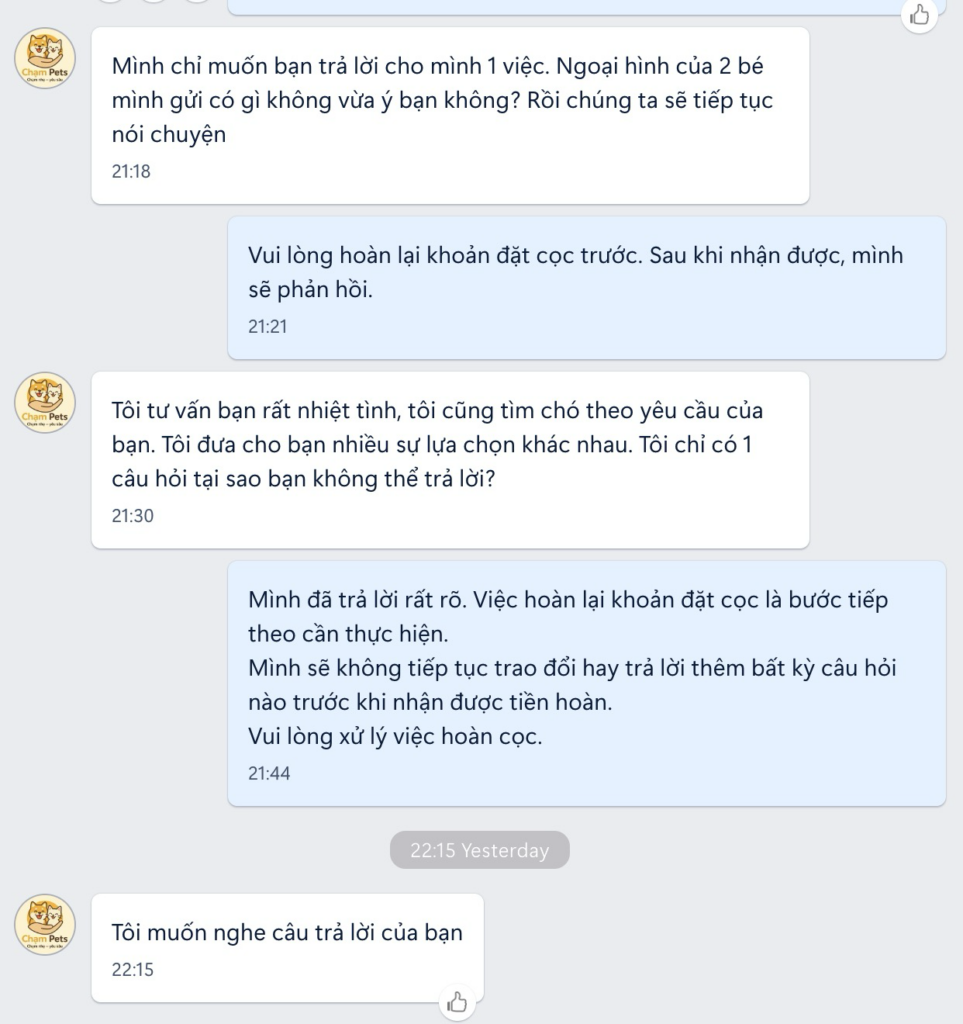
This is the moment trust died.
Once money is requested back and terms are terminated, continued persuasion is not diligence. It is coercive.
The dogs were never the real issue.
I never received dated photos of the three-year-old dog. I was not provided with independent veterinary documentation. I had no verifiable proof that the dog even existed at the time of the discussion.
That alone should concern any responsible buyer.
But the deeper issue was behavioural. A professional operator, in Vietnam or elsewhere, does one of two things when a deal ends. They either process the refund or clearly state, upfront, that deposits are non-refundable.
They do not interrogate the client while holding their money.
What this reveals about Cham Pets Family as a business.
This was not a cultural misunderstanding. Vietnamese professionals do not conduct themselves this way.
This was a low-trust micro-business attempting to substitute persistence for process. When there are no clear systems, no verification mechanisms, and no transparent exit rules, pressure becomes the primary tool.
That approach may work occasionally. It fails catastrophically with experienced clients who recognise the pattern.
Even if the refund were processed instantly, I would not take a dog from Cham Pets Family. Behaviour under pressure is predictive. This interaction revealed how future problems would be handled.
Tuesday 20th January
Leadership lessons.
Trust is built through systems, not enthusiasm.
Clear documentation, verifiable proof, and transparent refund policies create confidence far more effectively than repeated reassurance.
A boundary ignored once will be ignored again.
When a client states a condition is non-negotiable, continuing to push is not persuasion. It is a leadership failure.
Deposits signal seriousness, not surrender.
Treating a deposit as leverage rather than commitment poisons the relationship immediately.
Pressure after termination is a red flag.
When a refund request is met with argument rather than action, the business has already revealed its operating standard.
Culture explains style, not ethics.
Vietnamese business norms differ from Western ones. Withholding money while applying emotional pressure is not one of those norms.
Lesson for leaders
Trust does not collapse because a deal fails. It collapses because process is replaced with pressure.
When a client sets a clear, non-negotiable boundary, leadership shows up in what happens next. Professionals respect the boundary, act procedurally, and close cleanly. Low-trust businesses keep talking, keep persuading, and keep holding the money.
Persistence cannot compensate for weak systems.
Pressure cannot replace trust.
Final reflection.
This interaction began with goodwill and ended with distrust, not because of the product, but because of the process.
Leadership is most visible when someone says no. Cham Pets Family failed that test.
Image disclaimer
Screenshots are reproduced from original message records and payment confirmations, with personal and financial details removed where appropriate, to illustrate the chronology and context of the interaction.
Legal disclaimer
This article is a factual account of a real interaction between the author and Cham Pets Family, based on contemporaneous message records, payment receipts, and screenshots retained by the author. All statements reflect the author’s direct experience and honest opinion, expressed in good faith and for the purpose of commentary, consumer awareness, and leadership education. No claims are made beyond what is supported by documented communication. Cham Pets Family is named because the interaction is verifiable and materially relevant to the lessons discussed.